
Road and traffic signs
Signs
You MUST comply with all traffic signs and road markings. Road signs can be divided into groups depending on their shape and colour. Each group means something different.
-
Circular signs give orders.
-
Blue circles give an instruction.
-
Red circles tell you what you MUST NOT do.
-
Triangular signs give warnings.
-
Rectangular signs give information.
The exception to the shape rule is the ‘stop’ sign – this is octagonal to give it greater prominence and ensure that its meaning is understood even if it’s partly obscured; for example, by snow.
Maximum speed limits are shown inside red circles – you MUST NOT exceed the speed shown. National speed limits apply where no specific speed limits are indicated. Speed limit signs may be incorporated in other signs, such as those indicating a traffic-calmed area.
Know Your Traffic Signs shows all the signs that you’re likely to come across, while The Highway Code contains important advice and instructions on current GB legislation and best practice in road safety. It’s important that you familiarise yourself with these so that you do not inadvertently break the law.
Road markings
Markings on the road give information, orders, or warnings. As a general rule, the more paint, the more important the message.
There are 3 types of road markings.
Along the middle of the road
-
Short broken white lines divide lanes.
-
Longer broken white lines are hazard warning lines: only overtake if you can see that the road ahead is clear.
-
Double white lines with a solid white line on your side of the road – you MUST NOT cross or straddle the line.
-
White diagonal stripes or chevrons – these separate lanes of traffic or protect traffic turning right.
Along the side of the road
-
A white line shows the edge of the carriageway.
-
Yellow lines show waiting and stopping restrictions.
-
Zigzag lines (white at pedestrian crossings, yellow outside schools) mean no stopping or parking at any time.
Lines on or across the road
-
Broken lines across the road mean ‘give way’.
-
A solid line means ‘stop’.
-
Various markings on the road (for example, ‘give way’ triangles, road-hump markings, arrows) warn of a hazard.
As with signs, you should refer to Know Your Traffic Signs and The Highway Code to get the full picture on road markings.
Reflective studs may be found on motorways and other roads. These are especially useful at night and when visibility is poor.
Traffic lights and warning lights
At traffic lights, the sequence of lights and their meaning is:
-
red – stop and wait behind the stop line
-
red and amber – stop and wait
-
green – go, if the way is clear
-
amber – stop unless you’ve already crossed the stop line or you’re so close to it that pulling up might cause an incident
-
red – (as red, above).
There may be a green filter arrow. This means that you can go in the direction of the arrow, even if the main light is not showing green.
If the traffic lights are out of order, proceed with great care, as nobody has priority. This problem may be brought to your attention by a sign.
You’ll find red flashing lights at level crossings, lifting bridges or outside fire stations. Stop when these show.
On motorways, signals on the overhead gantries or at the roadside may be accompanied by flashing lights.
-
Amber – warns you of a hazard (for example, fog, lane closures, instruction to leave at the next exit) or a temporary maximum speed limit.
-
If red lights flash on a signal and a red X is showing, you MUST NOT drive in the lane shown as closed beyond the signal.
-
If red lights flash on a signal in the central reservation or on the side of the road and the lane closed sign is showing, you MUST NOT go beyond the signal in any lane. If red lights flash at the start of a slip road, you MUST NOT enter the slip road or try and join the motorway at that junction.
Signals given by other drivers
Drivers normally signal their intention to turn by using their indicators. Ensure that your indicators are cancelled after turning to avoid misleading other road users.
Be aware that another driver may have left their indicator on by mistake. For example, if you’re emerging from a junction and a driver coming along the main road from the right is indicating left, wait until the vehicle starts to turn before you emerge.
An arm signal may be used to strengthen or clarify the message given by your indicators, such as when you’re signalling to turn right in busy traffic.
If you’re slowing down and stopping just after a junction, wait to signal until you’re passing the junction or just after it.
Police may signal to you if they’re directing traffic. Ensure you know all arm signals and police signals in case you need to use them.
The horn may be used to warn others of your presence. It MUST NOT be used between 11:30pm and 7am. When stationary, only use your horn if another vehicle is likely to cause a danger.
The only reason that you should flash your headlights is to warn other road users that you’re there.
Signals given by police
A police officer following you in a patrol vehicle may flash their headlights or blue lights and/or use their siren or horn, then indicate left and point to the left, to get you to stop. Pull up on the left as soon as it’s safe to do so.
Traffic officers will use amber flashing lights, usually from behind, and will point or indicate left to get you to pull over.
Traffic officers operate in England and Wales, covering motorways and some ‘A’ class roads.
It’s an offence not to comply with directions given by police or traffic officers.
Use of road lanes
Contraflow lanes are lanes that flow in the opposite direction to most of the traffic. Bus and cycle contraflow lanes may be found in one-way streets. They’ll be signed and marked on the road. Do not enter these lanes.
You may also see contraflow lanes at roadworks. When you see the signs, reduce your speed in good time, choose an appropriate lane early and keep the correct separation distance from the vehicle in front.
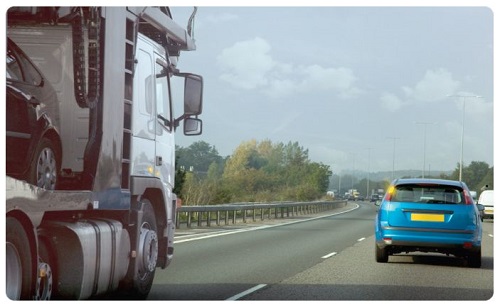
The centre and right-hand lane of a three-lane motorway are overtaking lanes. Always move back to a lane on your left after overtaking to allow other vehicles to overtake. You must not overtake on your left on a free-flowing motorway or dual carriageway.
FAQs
I’ve seen some signs with a brown background – does this mean anything in particular?
Signs with a brown background give tourist information.
Sometimes you see lorries with large arrows on the back. What do they mean?
These are placed on slow-moving or stationary maintenance vehicles which are blocking traffic lanes. They show you which side of the vehicle you should pass.
Can I use my hazard warning lights when I’m moving?
If you’re driving on a motorway or unrestricted dual carriageway, you can use hazard warning lights to warn drivers behind you that there’s an obstruction ahead.
Can I ever cross double white lines where there’s a solid white line on my side of the road?
You can cross a solid white line if you’re:
-
Turning into a side road on the right
-
Entering a property
-
Passing a stationary vehicle
-
Overtaking a bicycle, horse or road maintenance vehicle, if they’re travelling at 10 mph (16 km/h) or less.
Am I allowed to wait in a box junction?
Yes, if you want to turn right and your exit’s clear but you’re prevented from turning by oncoming traffic or by other vehicles waiting to turn right.
In what different ways can traffic be controlled at roadworks?
Traffic can be controlled by:
-
a police officer
-
traffic lights
-
a stop-go board.
About the Course
Our driving theory test course is designed to make learning simple, structured, and effective. With 14 modules and 140 bite-sized lessons, the entire syllabus is broken down into easy-to-digest sections you can work through at your own pace. Each module includes engaging videos, clear summaries in spider-diagram format, and a test to check your knowledge before moving on. You’ll also have access to unlimited mock exams and hazard perception practice, so you can build confidence as you go. Fully updated for 2026 and mobile-friendly, the course lets you study anytime, anywhere, and track your progress as you prepare for test success.
What You’ll Learn
- The complete driving theory syllabus, divided into 14 clear modules
- Key knowledge explained in short, manageable lessons
- How to spot and respond to hazards with practical hazard perception training
- Retain more information with videos, images, and spider diagram summaries
- Test your knowledge with module quizzes and unlimited mock tests
- Build confidence step by step by tracking your progress
- Study effectively on any device — PC, tablet, or mobile
- Be fully prepared with up-to-date material for 2026 and beyond
