
Alertness
Observation
Driving safely takes a lot of concentration. Look around constantly and assess the changing situations as you drive. Be aware of traffic all around you. Before you carry out any manoeuvre, such as moving off, stopping, turning or changing lanes, you should
-
use your mirrors to assess how your actions will affect traffic behind you
-
look around for a final check – remember windscreen pillars can obstruct your view
-
signal if necessary.
If you cannot see behind when reversing, ask a reliable person to guide you.
If you cannot see when emerging from a junction because your view is obstructed by parked cars, move forward slowly and carefully until you can get a proper view.
Be particularly careful before you overtake. Ensure that
-
you have a clear view of the road ahead – there should not be any bends or dips
-
you have enough time to complete the manoeuvre safely.
It’s also important for other road users to know you’re there.
-
When it starts to get dark, switch on your lights, even if the street lights are not on.
-
Where you cannot be seen, such as at a hump bridge, consider using your horn.
Anticipation and awareness
Look at the road signs and markings; these give you information about any hazards. You should
-
follow their advice
-
slow down if necessary.
Watch other road users. Try to anticipate their actions so you’re ready if you need to slow down or change direction.
When turning right onto a dual carriageway, first check that the central reservation is wide enough for your vehicle.
When following a large vehicle, stay well back. If you cannot see the vehicle’s mirrors, the driver may not be able to see you or know you’re there. Staying back will also help you to see the road ahead much more clearly.
Be aware of other, more vulnerable road users. Watch out for
-
pedestrians approaching a crossing, especially young, older or disabled people who may need more time to cross the road
-
cyclists – leave at least 1.5 metres of space when overtaking cyclists at speeds of up to 30 mph, and give them more space when overtaking at higher speeds
-
motorcyclists, who may be difficult to see
-
horses, which may be startled by the noise of your vehicle – pass horse riders and horse-drawn vehicles at speeds under 10 mph and allow at least 2 metres of space.
If you’re approaching traffic lights that have been green for some time, be prepared to stop because they may change.
However well prepared you are, you may still have to stop quickly in an emergency. Keep both hands on the wheel as you brake to keep control of your vehicle.
Concentration
Always plan your journey so you
-
know which route you need to take
-
have regular rest stops.
You will not be able to concentrate properly if you’re tired. It’s particularly easy to feel sleepy on a motorway, especially at night, so
-
do not drive continuously for more than 2 hours
-
keep fresh air circulating in the car
-
if you start to feel drowsy, leave at the next exit. Find a safe and legal place to stop and take a break.
Self-reflection: Sometimes it’s tempting to keep driving, no matter how tired you are. Plan rest breaks along your route; this will help you stay alert and arrive safely. Remember – when you drive tired, you’re 3 times as likely to be involved in a collision or a near-miss.
Distraction and Boredom
Do not let passengers distract you. Arguing or joking around will take your mind off driving. Loud music will also affect your concentration, and will make it difficult for you to hear sounds outside the car. Any of these things could cause you not to notice a potential hazard.
You can also be distracted by
-
objects hanging in the car
-
starting or adjusting any music or radio
-
looking at a map
-
talking into a microphone.
Just taking your eyes off the road for a second could be disastrous. In that second, at 60 mph (96 km/h), your car will travel 27 metres.
Using a hand-held mobile phone while you’re driving is illegal; it also drastically increases the chance of being involved in a collision. Be safe: switch your phone off or put it on voicemail. Wait until you’re parked legally in a safe place before you use your mobile phone to
-
retrieve any messages
-
make any calls
-
send or receive texts
-
go online.
If you’re driving on a motorway, you should leave the motorway and stop in a safe place before using your phone.
If your vehicle has a navigation system, stop in a safe place before programming the system. If you lose your way on a busy road, turn into a side road as soon as possible, stop and check a map.
FAQs
Is it OK to use a ‘hands-free’ phone when driving?
Just because it’s hands-free does not make it safe; it can still distract you. The person you’re talking to cannot see the traffic situation. They will not stop speaking to you if you’re approaching a hazard.
It’s safer not to use a phone at all if you’re driving. Wait and find a safe place to stop.
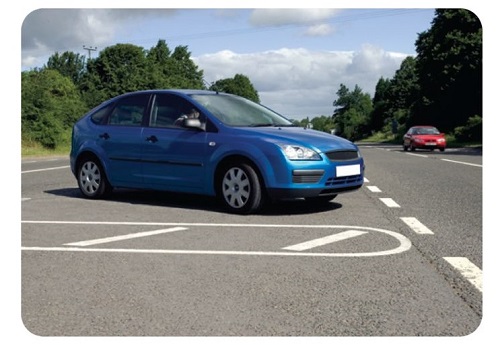
I’ve seen yellow lines painted at intervals across the road. What do they mean?
These encourage drivers to reduce their speed. They may be red. You often see them on the approach to a
-
hazard (such as a roundabout)
-
reduced speed limit.
I’ve heard the term ‘blind spot’. What does this mean?
Blind spots are any areas that are hidden from the driver, either by the car’s bodywork or areas not covered by the mirrors.
Be aware that a lorry driver cannot see you if you’re close behind. Keep well back so the driver can see you.
About the Course
Our driving theory test course is designed to make learning simple, structured, and effective. With 14 modules and 140 bite-sized lessons, the entire syllabus is broken down into easy-to-digest sections you can work through at your own pace. Each module includes engaging videos, clear summaries in spider-diagram format, and a test to check your knowledge before moving on. You’ll also have access to unlimited mock exams and hazard perception practice, so you can build confidence as you go. Fully updated for 2026 and mobile-friendly, the course lets you study anytime, anywhere, and track your progress as you prepare for test success.
What You’ll Learn
- The complete driving theory syllabus, divided into 14 clear modules
- Key knowledge explained in short, manageable lessons
- How to spot and respond to hazards with practical hazard perception training
- Retain more information with videos, images, and spider diagram summaries
- Test your knowledge with module quizzes and unlimited mock tests
- Build confidence step by step by tracking your progress
- Study effectively on any device — PC, tablet, or mobile
- Be fully prepared with up-to-date material for 2026 and beyond
