
Essential Documents
Introduction
Before you can legally drive on a public road, you MUST
• check that the vehicle tax has been paid on the vehicle you’re driving
• hold a valid driving licence
• have valid insurance cover
• make sure the vehicle you’re driving has a valid MOT certificate, if it requires one.
You will not be able to tax your vehicle unless you have a valid MOT certificate (if your vehicle requires one) and appropriate, current insurance documentation.
Licenses
The vehicle registration certificate (V5C) contains details of
• the vehicle (including make, model and engine size)
• the registered keeper.
You, the registered keeper, MUST notify the licensing authority when you change your vehicle, your name or your permanent address. If you buy a second-hand vehicle, notify them immediately of the change of ownership.
Vehicle tax MUST be paid on all motor vehicles used or kept on public roads (unless the vehicle is exempt).
If you’re not going to use your vehicle on public roads, you will not have to pay vehicle tax as long as you advise DVLA in advance. This is called a Statutory Off-Road Notification (SORN) and lasts until you tax, sell or scrap your vehicle.
Before driving on a public road, a learner MUST have a valid provisional driving licence.
You MUST notify the licensing authority if
• your health is likely to affect your driving
• your eyesight does not meet the required standard.
Insurance
You MUST have at least third-party insurance cover before driving on public roads. This covers
• injury to another person
• damage to someone else’s property
• damage to other vehicles.
Driving without insurance is a criminal offence. It can lead to an unlimited fine, and possibly disqualification.
You’ll need to show your insurance certificate when you’re taxing your vehicle or if a police officer asks you for it. You may be issued with a temporary cover note until you receive your insurance certificate.
Before you drive anyone else’s vehicle, make sure that the vehicle is insured for your use.
The cost of your insurance depends on many factors, but it’s generally lower if you
• are over 25 years old
• complete the Pass Plus scheme (this is not available in Northern Ireland).
Your insurance policy may have an excess of, for example, £100. This means that you’ll have to pay the first £100 of any claim for damage to your vehicle.
The Pass Plus scheme will help newly qualified drivers widen their driving experience and improve their basic skills. It may also help to reduce insurance costs.
MOT test
Cars MUST first have an MOT test when they’re 3 years old (4 in Northern Ireland). MOT certificates are valid for one year.
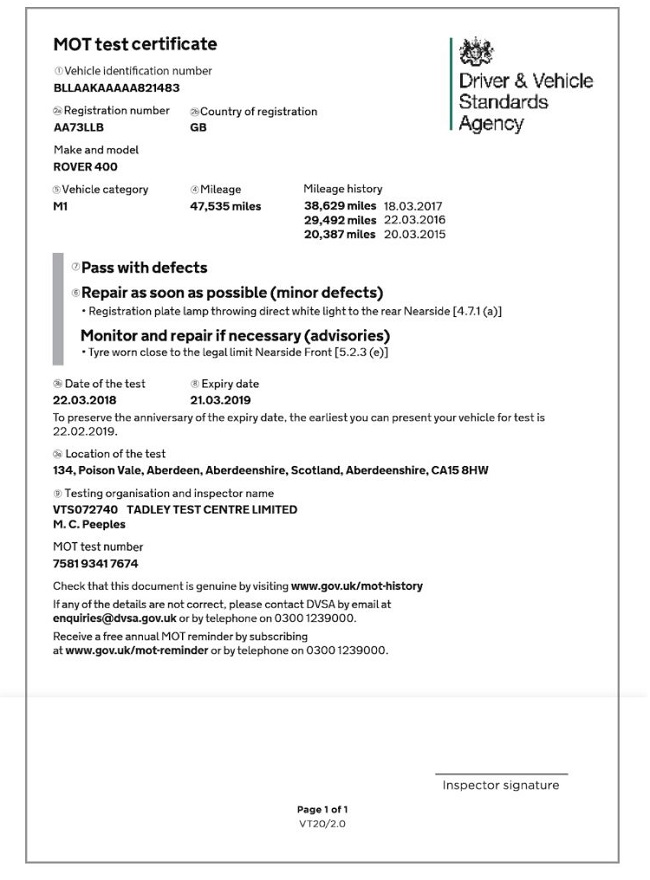
Trailers and caravans do not need an MOT, but they do need to be kept in good order.
Unless your car is exempt from MOT testing (see gov.uk for exemption rules) the only time when you can drive your car without an MOT certificate is when driving to or from an appointment at an MOT centre or to have MOT repairs carried out.
If your vehicle needs an MOT certificate and you do not have one
-
you won’t be able to renew your vehicle tax
-
you could be prosecuted
-
it could invalidate your insurance.
FAQs
What happens if the police ask to see my documents and I do not have them with me?
You can produce them at a police station within 7 days.
If I want to get some practice while I’m learning to drive, who can accompany me?
The person accompanying you MUST be 21 years old and have held (and still hold) a full licence for 3 years.
What is the Pass Plus scheme?
This is a scheme designed to improve your basic driving skills once you’ve passed your practical driving test. Ask your ADI, call DVSA on 0115 936 6504 or visit www.gov.uk/pass-plus for details. (Pass Plus is not available in Northern Ireland.)
I’ve heard that I’m on probation for 2 years after I’ve passed my test. What does this mean?
If you get 6 or more penalty points within 2 years of passing your practical test, you’ll lose your licence. You’ll then have to
-
reapply for a provisional licence
-
retake your theory and practical tests.
Any points on your provisional licence will be transferred onto your new licence when you pass your test.
About the Course
Our driving theory test course is designed to make learning simple, structured, and effective. With 14 modules and 140 bite-sized lessons, the entire syllabus is broken down into easy-to-digest sections you can work through at your own pace. Each module includes engaging videos, clear summaries in spider-diagram format, and a test to check your knowledge before moving on. You’ll also have access to unlimited mock exams and hazard perception practice, so you can build confidence as you go. Fully updated for 2026 and mobile-friendly, the course lets you study anytime, anywhere, and track your progress as you prepare for test success.
What You’ll Learn
- The complete driving theory syllabus, divided into 14 clear modules
- Key knowledge explained in short, manageable lessons
- How to spot and respond to hazards with practical hazard perception training
- Retain more information with videos, images, and spider diagram summaries
- Test your knowledge with module quizzes and unlimited mock tests
- Build confidence step by step by tracking your progress
- Study effectively on any device — PC, tablet, or mobile
- Be fully prepared with up-to-date material for 2026 and beyond
