
Hazard awareness
Introduction
When you start to learn to drive, you’ll be concentrating on the basic controls of the car. As your skill improves, so will your ability to recognise hazards on the road.
A hazard is a situation which may require you as a driver to respond by taking action, such as braking or steering. Hazards can be
-
static hazards – such as parked cars, roundabouts and junctions
-
moving hazards – other road users
-
road and weather conditions
-
you, if you’re not alert and fit to drive.
Static hazards
There are numerous types of static hazard, including bends, junctions, roundabouts, parked vehicles and skips in the road, roadworks, traffic calming, different types of crossing and traffic lights.
All of these may require you to respond in some way, so
-
take a mental note of their existence
-
slow down and get ready to stop if necessary.
Road signs and markings are there to give you clues. Learn their meanings. Watch out for them so that you can reduce your speed in good time and prepare yourself for any action you may need to take. The same applies to traffic lights, other light signals, level crossings and signals from police officers. If traffic lights are out of order, treat the junction as an unmarked crossroads and proceed with caution.
If you see a sign for a bend, ask yourself ‘What if there’s a pedestrian or obstruction just around the bend. Could I stop in time? Could I do it safely?’
In busy areas, parked cars can cause a hazard, especially if parked illegally; for example, on the zigzag lines by a pedestrian crossing. Watch out for
-
children dashing out from between the cars
-
car doors opening
-
cars moving away.
Would you be able to stop?
Near schools, watch for the flashing amber lights, indicating children may be crossing the road or using a dedicated school-crossing-patrol point.
Slow down and be ready to stop if necessary or when signalled to do so.
There’s often reduced visibility at junctions, especially in built-up areas. Take extra care and pull forward slowly until you can see down the road. You may also be able to see reflections of traffic in shop windows.
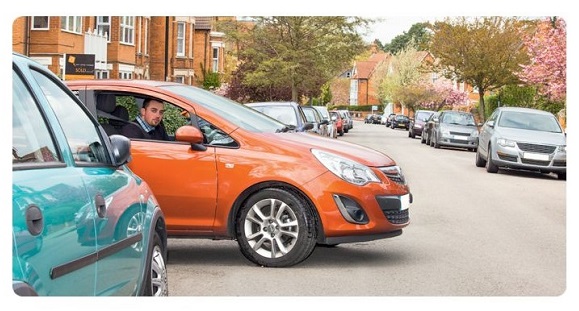
Do not block a junction; leave it clear to allow vehicles to enter and emerge.
Where lanes are closed, be ready for cars cutting in front of you and keep a safe distance from the vehicle in front. Take extra care on two-way roads that have a third lane in the centre. Traffic from both directions can use this lane for overtaking.
If you’re driving on a motorway or dual carriageway and see a hazard or obstruction ahead, briefly use your hazard warning lights to warn the traffic behind.
If your vehicle has broken down and is causing an obstruction, switch on your hazard warning lights to warn other road users.
Moving hazards
You need to look out for other road users: pedestrians, cyclists, horse riders, large vehicle drivers, slow-moving vehicles, motorcyclists, disabled people using a powered vehicle, and other car drivers.
In built-up areas, if you see pedestrians crossing the road, be patient and do not try to make them rush.
On country roads, there may be no pavement, so look out for pedestrians walking along the road. They may be walking towards you on your side of the road. Allow at least 2 metres of space and keep to a low speed when passing a pedestrian who is walking in the road.
Be aware of cyclists and give them at least 1.5 metres of room at speeds up to 30 mph, more if you’re travelling faster.
• They may wobble or swerve to avoid drains or potholes.
• At junctions or traffic lights, give them time to turn or pull away.
• Before you turn left, check for cyclists filtering on your left.
If you see a bus at a bus stop, think.
• People may get off the bus and cross the road.
• The bus may be about to move off. School buses might stop at places other than bus stops.
At some bridges, high vehicles may need to use the centre of the road to be able to pass underneath.
Watch out for other vehicles, especially motorcyclists, overtaking and cutting in front of you. If you need to, drop back to retain a safe separation distance.
Older drivers may not react very quickly, so be patient with them.
Some vehicles have information signs on the back; for example, road maintenance vehicles, heavy goods vehicles over 13 metres long, and vehicles carrying hazardous chemicals. Learn what the signs mean.
Do not overtake
• if you’re turning left shortly afterwards
• if signs and road markings prohibit this
• when approaching a junction
• when the view ahead is blocked.
Yourself
Do not allow yourself to become a hazard on the road. You need to be alert at all times.
Make sure you use your mirrors so you’re aware of what’s going on around you at all times. These may be convex to give a wider field of vision.
Do not drive if you’re tired. Plan your journey so that you have enough rest and refreshment breaks. Try to stop at least once every 2 hours. Always make sure you have plenty of fresh air in your car by opening a window.
If you feel tired
-
pull over at a safe and legal place to rest
-
on a motorway, leave at the next exit or services.
Your concentration can also be affected by
-
using a hands-free phone
-
listening to loud music
-
looking at navigation equipment
-
how you’re feeling.
Self-reflection: Switch off your phone and put it in the glove compartment before you drive. If you’re carrying passengers, ask them to check that you’ve stored the phone out of reach. You can get 6 penalty points and a £200 fine if you use a handheld phone when you’re driving. You’ll also lose your licence if you passed your driving test in the last 2 years.
If you’ve had an argument, calm down before starting or continuing your journey.
Never drive if you’ve been drinking alcohol. It’s not worth taking a chance. If you’re driving, do not drink alcohol. If you’ve had a drink, go home by public transport. If you drive to a social event, stick to non-alcoholic drinks.
Alcohol
-
reduces concentration, coordination and control
-
gives a false sense of confidence
-
reduces your judgement of speed
-
slows down your reactions.
You must be fit to drive. Some medicines can make you sleepy; check the label or ask your doctor or pharmacist if it’s safe to drive after you’ve taken the medicine.
Using illegal drugs is highly dangerous and the effects of some can last up to 72 hours. Never take them before driving. If you’ve been convicted of driving whilst unfit through drink or drugs, the cost of your insurance will rise considerably.
Your eyesight should be of a safe standard. If you need glasses to drive, wear them every time you drive. If you cannot find them, do not drive. Do not wear tinted glasses at night.
You MUST tell the licensing authority if
• your eyesight deteriorates
• you suffer from an illness which may affect your driving.
Road and weather conditions
Different types of weather can change a normal stretch of road into a hazard. Rain, ice, fog and even bright sunlight can have an effect on safety. Drive accordingly and be aware of the added dangers.
In wet weather
-
double your separation distance to 4 seconds
-
spray may reduce your vision.
In icy weather
-
slow down
-
increase your separation distance: allow up to 10 times the gap you’d leave in the dry.
In fog
-
slow down
-
use dipped headlights
-
use fog lights if visibility is less than 100 metres (328 feet).
In bright sunlight
-
be aware that sunlight – especially low winter sun – can dazzle you or other drivers.
FAQs
How do I deal with inconsiderate drivers?
There are occasions when we all make misjudgements or mistakes. Be aware that other drivers might not always follow the rules. Stay calm. Do not shout or make rude gestures; this will not help the situation at all.
-
Wait if necessary to allow the other driver to move out of the way.
-
If you feel upset, stop and take a break if you can.
Good anticipation skills can help to prevent these situations becoming more serious incidents.
How do you prevent the car behind driving too closely?
Move over and let the car through if you can. If there’s no room and the driver behind seems to be ‘pushing’ you, increase your distance from the car in front. This will lessen the risk of a road traffic incident involving several vehicles.
Why are two-way roads divided into 3 lanes more dangerous?
Traffic in both directions can use the middle lane to overtake, so approaching traffic could be intending to make the same manoeuvre at the same time.
What do I do if a car is about to reverse out in front of me?
Reduce your speed and be prepared to stop.
Sound your horn to warn them you’re there (in built-up areas between 11:30pm and 7am, flash your headlights instead).
What do I do if I take the wrong route and find myself in a one-way street?
Do not try to turn round in a one-way street.
Continue to the end of the road and then find a safe place to turn round.
What do I do if it looks like the driver in front has forgotten to cancel their right indicator?
Be cautious. Stay behind and do not overtake – they may be unsure of the position of a junction and turn suddenly.
About the Course
Our driving theory test course is designed to make learning simple, structured, and effective. With 14 modules and 140 bite-sized lessons, the entire syllabus is broken down into easy-to-digest sections you can work through at your own pace. Each module includes engaging videos, clear summaries in spider-diagram format, and a test to check your knowledge before moving on. You’ll also have access to unlimited mock exams and hazard perception practice, so you can build confidence as you go. Fully updated for 2026 and mobile-friendly, the course lets you study anytime, anywhere, and track your progress as you prepare for test success.
What You’ll Learn
- The complete driving theory syllabus, divided into 14 clear modules
- Key knowledge explained in short, manageable lessons
- How to spot and respond to hazards with practical hazard perception training
- Retain more information with videos, images, and spider diagram summaries
- Test your knowledge with module quizzes and unlimited mock tests
- Build confidence step by step by tracking your progress
- Study effectively on any device — PC, tablet, or mobile
- Be fully prepared with up-to-date material for 2026 and beyond
