
Incidents, accidents and emergencies
Breakdowns
If a warning light on the instrument panel of your vehicle comes on while you’re driving, stop (as soon as you can do so safely) and investigate the problem.
If your tyre bursts or you get a puncture while you’re driving
• hold the steering wheel firmly
• pull up slowly or roll to a stop at the side of the road.
If you break down on the motorway, try and reach the next exit or service area. If you cannot do this, move into the left-hand lane and then steer your vehicle into an emergency area or onto the hard shoulder, as safely as possible.
On the hard shoulder, try and stop just beyond an emergency phone and as far to the left as you can, away from the traffic. Leave enough space so that you can get out of the vehicle using the nearside door.
If you are unable to exit your vehicle call 999 immediately and ask for the police. Alternatively, press your SOS button if your vehicle has one and ask for the police.
If you have any kind of mobility difficulty, you should stay in your vehicle, keep your seat belt fastened and switch on your hazard warning lights then call 999 and ask for the police.
If you break down on a level crossing, get everyone out of the vehicle and clear of the crossing. Then call the signal operator from the phone provided. Only move your vehicle if the operator tells you to do so.
Safety in tunnels
Before driving through a tunnel, remove any sunglasses and switch on dipped headlights. It’s particularly important to keep a safe distance from the vehicle in front when driving in a tunnel, even if it’s congested.
Look out for variable message signs that warn of incidents or congestion.
If your vehicle, or the vehicle in front, is involved in an incident or breaks down in a tunnel
• switch off the engine
• switch on your hazard warning lights
• go and call for help immediately from the nearest emergency telephone point.
If your vehicle catches fire while you’re driving through a tunnel, drive it out of the tunnel, if you can do so without causing further danger. If this is not possible, then you should
• stop
• switch on your hazard warning lights
• try to put out the fire (only if it’s a small fire)
• call for help at the nearest emergency point.
Warning others of an incident
Use your hazard warning lights
-
if you need to suddenly slow down or stop on a motorway or unrestricted dual carriageway because of an incident or hazard ahead
-
when you’re broken down or stopped and temporarily obstructing traffic.
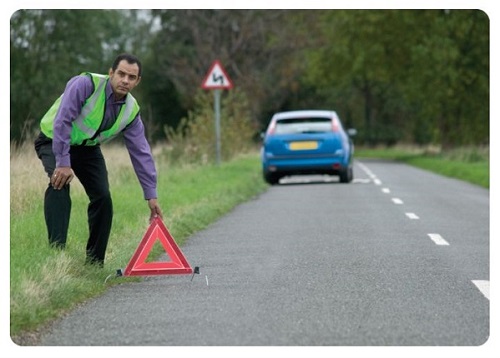
If you have a warning triangle, place it at least 45 metres (147 feet) behind your vehicle. This will warn other road users that you’ve broken down. However, never use a warning triangle on a motorway.
Stopping at an incident
If you’re the first to arrive at the scene of an incident or crash, stop and warn other traffic. Switch on your hazard warning lights. Don’t put yourself at risk.
-
Make sure the emergency services are called as soon as possible.
-
Check that the engines of any vehicles at the scene are switched off.
-
Move uninjured people away from the scene.
A vehicle carrying dangerous goods will display an orange label or a hazard warning plate on the back. Report what it says when you call the emergency services. The different plates are shown in The Highway Code.
First aid
Even if you do not know any first aid, you can help any injured people by
-
calling the emergency services on 999 or 112
-
keeping them warm and comfortable
-
keeping them calm by talking to them reassuringly
-
making sure that they’re not left alone.
Do not move them if the area is safe. Only move them if they’re in obvious danger, and then with extreme care. If a motorcyclist is involved, never remove their helmet unless it’s essential in order to keep them alive, as removal of the helmet could cause more serious injury. Always seek medical assistance.
Never offer a casualty any food or drink.
If the casualty is unconscious, check that they can breathe normally. If they can, place them in the recovery position until medical help arrives. Keep checking them and make sure their airway remains clear.
If you need to provide emergency care, follow the steps below.
Danger
Check that it’s safe to approach.
Response
Try to get a response by gently shaking the casualty’s shoulders and asking loudly ‘Are you all right?’ If they respond, check for injuries. For motorcyclists, this step can be done with the helmet on.
Airway
If there’s no response, open the casualty’s airway by placing your fingers under their chin and lifting it forward. If dealing with a motorcyclist, gently remove their helmet before attempting this stage.
Breathing
Check that the casualty is breathing normally. Look for chest movements, look and listen for breathing, and feel for breath on your cheek. If there are no signs of normal breathing, start cardiopulmonary resuscitation (CPR).
CPR
Interlock your fingers, and place your hands in the centre of the casualty’s chest and press down hard and fast – for adults, this is around 5 to 6 centimetres and about twice a second. You may only need one hand for a child and should press down 4 to 5 centimetres. For infants, use 2 fingers in the middle of the chest and press down about a third of the chest depth. Do not stop until the casualty starts breathing again or a healthcare professional takes over.
Defibrillation
If you have assistance, the operator will direct you to the nearest public access defibrillator. Never stop CPR; send someone else to fetch the defibrillator for you.
Anyone can use an AED – you do not need to be trained. It’s easy to use – just follow the verbal and visual instructions.
Circulation
If the casualty is responsive and breathing, check for signs of bleeding. Protect yourself from exposure to blood and check for anything that may be in the wound, such as glass. Do not remove anything that’s stuck in the wound. Taking care not to press on the object, build up padding on either side of the object. If nothing is embedded, apply firm pressure over the wound to stem the flow of blood. As soon as practical, fasten a pad to the wound with a bandage or length of cloth. Use the cleanest material available.
People at the scene may be suffering from shock. Warning signs include a rapid pulse, sweating and pale grey skin.
-
Reassure them confidently.
-
Keep them warm.
-
Loosen any tight clothing around their neck, chest and waist.
-
Lie them down with their legs raised and supported.
-
Make sure they’re not left alone.
-
Do not give them anything to eat or drink.
-
Talk firmly and quietly to them if they are hysterical.
If someone is suffering from burns
-
douse the burns thoroughly with cool water for at least 20 minutes
-
do not remove anything sticking to the burn.
Reporting
You MUST stop and give your name and address if you’re involved in an incident. If there’s damage to another vehicle, property or animal, report it to the owner. If you do not do this at the time, you MUST report the incident to the police as soon as is reasonably practicable, and in any case within 24 hours (immediately in Northern Ireland).
If another person is injured and you do not produce your insurance certificate at the time of the incident, you MUST report the incident to the police as soon as is reasonably practicable, and in any case within 24 hours (immediately in Northern Ireland).
If another vehicle is involved, find out
• whether the other driver owns the vehicle
• the make and registration number of the vehicle
• the other driver’s name, address and telephone number and details of their insurance.
Following an incident (or at any other time), the police may ask you to produce
• your insurance certificate
• the MOT certificate for the vehicle you’re driving
• your driving licence.
FAQs
What should I do if I see something fall from a lorry on the motorway?
Stop at the next emergency telephone and report the hazard to the police. Do the same if anything falls from your own vehicle – do not try to retrieve it yourself.
What should I do if my engine catches fire?
Pull up as quickly and safely as possible. Get yourself and any passengers out and away from the vehicle. Then call the fire service. Do not open the bonnet, as this would make the fire worse.
What would you suggest I carry in my car for use in an emergency?
It’s useful to have a first aid kit, a warning triangle and a fire extinguisher. This equipment could be invaluable and is worth buying if it helps to prevent or lessen an injury.
What should I do if I smell petrol?
Stop and investigate as soon as you can do so safely. Do not ignore it. It can be useful to carry a fire extinguisher, which may help in tackling a small fire, but do not take any risks.
About the Course
Our driving theory test course is designed to make learning simple, structured, and effective. With 14 modules and 140 bite-sized lessons, the entire syllabus is broken down into easy-to-digest sections you can work through at your own pace. Each module includes engaging videos, clear summaries in spider-diagram format, and a test to check your knowledge before moving on. You’ll also have access to unlimited mock exams and hazard perception practice, so you can build confidence as you go. Fully updated for 2026 and mobile-friendly, the course lets you study anytime, anywhere, and track your progress as you prepare for test success.
What You’ll Learn
- The complete driving theory syllabus, divided into 14 clear modules
- Key knowledge explained in short, manageable lessons
- How to spot and respond to hazards with practical hazard perception training
- Retain more information with videos, images, and spider diagram summaries
- Test your knowledge with module quizzes and unlimited mock tests
- Build confidence step by step by tracking your progress
- Study effectively on any device — PC, tablet, or mobile
- Be fully prepared with up-to-date material for 2026 and beyond
