
Motorway rules
Introduction
Motorways are designed to help traffic travel faster. Conditions can change more quickly than on other roads, so you need to be especially alert at all times.
Check your vehicle thoroughly before starting a long motorway journey. Continuous high speeds may increase the risk of your vehicle breaking down.
Driving on the motorway
When you join the motorway from a slip road
-
adjust your speed to match the speed of the traffic already on the motorway
-
always give way to traffic already on the motorway
Once you’ve joined the motorway, keep in the left-hand lane while you get used to the higher speeds of motorway traffic.
All traffic should normally use the left-hand lane of the motorway unless overtaking, regardless of the speed they’re travelling. Use the middle and right-hand lanes only for overtaking other vehicles.
When you overtake
-
normally only overtake on the right
-
you may overtake on the left if traffic is moving slowly in queues and the queue on your right is moving more slowly than the one you’re in.
Where there’s a steep uphill gradient, a separate lane may be provided for slow-moving vehicles. This helps the faster-moving traffic to flow more easily.
If you’re travelling in the left-hand lane and traffic is joining from a slip road, move to another lane if you’re able. This helps the flow of traffic joining the motorway, especially at peak times.
Countdown markers on the left-hand verge indicate that you’re approaching the next exit. If you want to leave the motorway, try to get into the left-hand lane in good time. If, by mistake, you go past the exit you wanted, carry on to the next one. Never try to stop or reverse.
Self-reflection: Does the thought of driving on motorways make you anxious? Your instructor will only take you on a motorway when you’re ready. They’ll be able to help you prepare by talking you through the practical driving skills you’ll need to drive on motorways and by giving you techniques to help you to manage your anxiety and stay focused on the road.
Speed limits
The national speed limit for cars and motorcycles on a motorway is 70 mph (112 km/h). The same limit applies to all lanes. Obey any signs showing a lower speed limit.
A vehicle towing a trailer
-
is restricted to a lower speed limit of 60 mph (96 km/h)
-
is not allowed to travel in the right-hand lane of a three-lane motorway unless there are lane closures.
In Northern Ireland, a vehicle towing a trailer should not use the right-hand lane of a three-lane motorway.
You can use your hazard lights to show traffic behind that the traffic ahead is slowing down or stopping suddenly. Switch them off as soon as a queue forms behind you.
As you approach any roadworks, take extra care. There are usually lower speed limits, especially if there’s a contraflow system.
-
Obey all speed limits.
-
Keep a good distance from the vehicle ahead.
Reducing congestion
Traffic management tries to reduce congestion and make journey times more reliable. Where this is in use, mandatory speed limit signs will show on the gantries. The speed limit helps to keep the traffic speed so that bunching will be reduced and journey times can be improved.
Sometimes the hard shoulder is used as a normal traffic lane. You’ll know when you can use this because a speed-limit sign will be shown above all lanes, including the hard shoulder. A red cross showing above the hard shoulder means that you should not travel in this lane and it should be used only in an emergency or breakdown.
Emergency areas have been built in these areas for use in cases of emergency or breakdown.
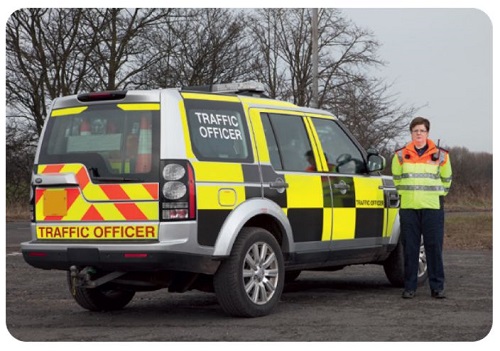
Traffic officers operate in England and Wales, covering motorways and some ‘A’ class roads.
They
• can stop and direct anyone on a motorway or an ‘A’ road
• respond to calls made on roadside emergency telephones.
Lane markings
Reflective studs help you to identify your position on the carriageway, especially at night or in fog.
The different colours are as follows
-
red – between the hard shoulder and carriageway
-
amber – between the edge of the carriageway and the central reservation
-
white – between lanes
-
green – between the carriageway and slip roads
-
fluorescent green/yellow – at contraflow systems and roadworks.
Stopping and breakdowns
Only stop on the motorway
-
if flashing red lights show above every lane
-
when told to do so by the police or traffic officers
-
in a traffic jam
-
in an emergency or breakdown.
Move over if signals on the overhead gantries advise you to do so.
Only stop on the hard shoulder in an emergency. To stop for any other reason, such as to have a rest or look at a map, either leave at the next exit or go to a service area.
If your vehicle breaks down or has a puncture, try to get onto the hard shoulder and call for help. If you can, use one of the emergency telephones, which are
-
normally at one-mile intervals. Marker posts at 100-metre intervals point you in the direction of the nearest phone
-
connected directly to a control centre, where the operator will deal with your call and direct the appropriate services to help you.
When using an emergency phone, stand and face oncoming traffic. You can then see any hazards approaching – for example, the draught from a large vehicle could unsteady you if you’re taken unawares. If you decide to use your mobile phone
-
check your location (the number on the nearest marker post) before you make the call
-
give this information to the emergency services.
When you’re ready to return to the carriageway, drive along the hard shoulder to gain speed before rejoining the main carriageway by moving into a safe gap in the traffic. If you’re not able to get onto the hard shoulder when you break down
-
switch on your hazard warning lights
-
leave your vehicle only when you can get off the carriageway safely.
FAQs
Can I drive on a motorway with a provisional car or motorcycle licence?
Motorcyclists with provisional entitlement may not ride on the motorway. Learner drivers can have driving lessons on motorways but only with an approved driving instructor (ADI) and in a car fitted with dual controls that’s clearly displaying L plates.
How should I negotiate a contraflow system?
Keep a good distance from the vehicle in front, and observe the lower speed restriction. Take care, as the lanes are likely to be narrower and there may be no permanent barrier between you and oncoming traffic. Keep to your lane, and do not switch lanes unnecessarily.
Pedestrians and horse riders MUST NOT use a motorway, but what vehicles MUST NOT be used on a motorway?
The following vehicles MUST NOT be used on a motorway
-
bicycles
-
motorcycles under 50 cc
-
powered wheelchairs or mobility scooters
-
agricultural vehicles
-
some slow-moving vehicles.
About the Course
Our driving theory test course is designed to make learning simple, structured, and effective. With 14 modules and 140 bite-sized lessons, the entire syllabus is broken down into easy-to-digest sections you can work through at your own pace. Each module includes engaging videos, clear summaries in spider-diagram format, and a test to check your knowledge before moving on. You’ll also have access to unlimited mock exams and hazard perception practice, so you can build confidence as you go. Fully updated for 2026 and mobile-friendly, the course lets you study anytime, anywhere, and track your progress as you prepare for test success.
What You’ll Learn
- The complete driving theory syllabus, divided into 14 clear modules
- Key knowledge explained in short, manageable lessons
- How to spot and respond to hazards with practical hazard perception training
- Retain more information with videos, images, and spider diagram summaries
- Test your knowledge with module quizzes and unlimited mock tests
- Build confidence step by step by tracking your progress
- Study effectively on any device — PC, tablet, or mobile
- Be fully prepared with up-to-date material for 2026 and beyond
