
Rules of the road
Introduction
It’s important that everyone knows and follows the rules of the road. Some rules are legal requirements and some are just recommended best practice, but all help to make the roads safer. Study The Highway Code, which distinguishes between advisory and mandatory rules by the use of MUST or MUST NOT in red within the rule.
Speed limits
You MUST NOT exceed the speed limit for the road you’re on or your vehicle. Where no other limit is shown, the national speed limit for cars and motorcycles is:
-
60 mph (96 km/h) on a single carriageway road
-
70 mph (112 km/h) on a dual carriageway or motorway.
Lower speed limits of:
-
50 mph (80 km/h) on a single carriageway road
-
60 mph (96 km/h) on a dual carriageway or motorway
apply for vehicles towing a trailer or caravan.
In England, Scotland and Northern Ireland, where there are street lights there’s normally a 30 mph (48 km/h) speed limit for all vehicles unless signs show otherwise. In Wales, the speed limit where there are street lights is 20 mph (32 km/h) unless signs show otherwise.
On some roads you may also see a sign showing a minimum speed limit. You should travel above the limit shown on the sign unless it’s not safe to do so.
Self-reflection: Do you sometimes go over the speed limit? Ask your instructor to help you identify correct speed limits. Talk to them about how to keep to a speed that’s appropriate for the driving conditions. The speed limit is the absolute maximum. It does not mean that it’s safe to drive at that speed whatever the conditions. Driving at speeds too fast for the road and traffic conditions is dangerous.
Always drive with care and according to the conditions. If you’re going along a street where cars are parked, keep your speed down and beware of:
-
pedestrians (especially children) emerging from behind or between parked vehicles
-
vehicles pulling out
-
drivers’ doors opening.
At roadworks, there may be temporary speed limits to slow traffic. Always obey these signs.
Lanes and junctions
Some roads have lanes reserved for specific vehicles, such as bicycles, buses, trams or, in some places, motorcycles. These are marked by signs and road markings, and must be used only by those vehicles during the lanes’ hours of operation.
Never drive or park in a cycle lane marked by a solid white line during its period of operation. Do not drive or park in one marked by a broken line unless it’s unavoidable.
Only drive over a footpath to gain access to a property.
On a dual carriageway, the right-hand lane is only for turning right or overtaking. The same rule applies to three-lane dual carriageways.
Treat junctions with extra care. On approach, move into the appropriate position in good time. If you’re going to turn left, keep well to the left as you approach the junction. In slow-moving traffic, remember to check for cyclists to your left before you turn.
If you’re turning right at a crossroads when an oncoming driver is also turning right, it’s normally safest to keep the other vehicle to your right and turn behind it. If you have to pass in front of the other vehicle, take extra care as your view may be obscured.
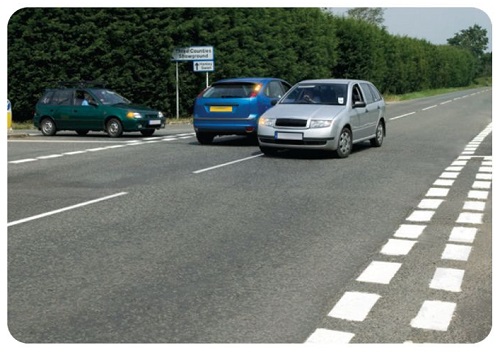
If you’re turning right onto a dual carriageway that has a central reservation that’s too narrow to fit the length of your vehicle, wait until the road is clear in both directions before you emerge.
A box junction – indicated by yellow hatched lines – should be kept clear. Only enter it if your exit road is clear. You may wait in the box if you want to turn right and are only prevented from doing so by oncoming traffic.
At crossroads where there are not any signs or markings, no-one has priority. Check very carefully in all directions before you proceed.
Roundabouts are designed to aid the flow of traffic. Follow signs and road markings as you approach and negotiate these. Normally, if you’re going straight ahead
-
do not signal as you approach
-
signal left before you leave the roundabout, just after you pass the exit before the one you want.
Some vehicles may not follow the normal rules, so
-
cyclists and horse riders may stay in the left-hand lane even if they’re turning right
-
long vehicles may take up a different position to stop the rear of the vehicle hitting the kerb.
Overtaking, turning and reversing
Overtaking can be dangerous. Ask yourself if you really need to overtake and never do so if you’re in any doubt as to whether it’s safe.
You should normally overtake on the right, but in a one-way street you can overtake on either side.
Take extra care if you’re overtaking on a dual carriageway, as the right-hand lane can also be used by traffic turning right.
If you’re on a busy road and find that you’re
-
travelling in the wrong direction
-
in the wrong lane at a busy junction
keep going until you can find somewhere safe, such as a quiet side road, in which to turn round.
Never reverse.
-
for longer than is necessary
-
from a side road into a main road.
When reversing into a side road, always check road and traffic conditions in all directions (you may remove your seat belt while reversing if it helps you get a better view). If you’re not sure that it’s safe, get out and check before you start to reverse. The greatest hazard to passing traffic is when the front of your vehicle swings out.
Crossings
If someone is standing on the pavement waiting to cross at a zebra crossing, stop (as long as it’s safe to do so) and let them cross.
Pelican crossings are light-controlled. When the red light changes to flashing amber, wait for any pedestrians to get clear of the crossing before moving off.
On toucan crossings, cyclists are allowed to cycle across at the same time as pedestrians walk.
Level crossings
A level crossing, where a railway line crosses the road, may have countdown markers to warn you if the crossing is hidden, such as round a bend.
-
If the warning lights come on as you’re approaching the crossing – stop.
-
If you’re already on the crossing when the warning lights come on or a bell rings – keep going and clear the crossing.
-
If you’re waiting at a level crossing, a train has passed but the red lights keep flashing – wait. There may be another train coming.
Stopping and parking
At night, the safest place to park your vehicle is in your garage, if you have one. If you’re away from home, try to find a secure car park or park in a well-lit area.
If you have to park on a road, you MUST leave your sidelights on if the speed limit on that road is over 30 mph. Normally park on the left-hand side of the road so other road users can see your reflectors, but in a one-way street you can park on either side.
Never stop on a clearway. On an urban clearway or a road marked with double white lines (even where one of the lines is broken), you may stop only to set down and pick up passengers.
Do not park where you would cause a danger or obstruction to others, such as
- on or near the brow of a hill
- at a bus stop
- opposite a traffic island
- in front of someone else’s drive
- near a school entrance
- within 10 metres (32 feet) of a junction (in Northern Ireland, within 15 metres or 48 feet of a junction).
Do not cause an obstruction by stopping or parking where there are restrictions such as yellow lines and associated signs. In a controlled parking zone, you’ll have to pay to park. Park within marked bays on the days and times shown on the zone entry signs.
Only park in a disabled parking space if you or your passenger are a disabled badge holder. Remember to display the badge when you leave the vehicle.
Smoking
It’s illegal to smoke in a private enclosed vehicle if one or more of the occupants is under 18.
This means that it’s an offence
-
for a person of any age to smoke in a private vehicle that’s carrying someone under 18
-
for a driver (including a provisional driver) not to stop someone smoking if one of the occupants is under 18.
The rules do not apply to e-cigarettes.
FAQs
What do I do if there’s an obstruction on my side of the road?
Give way to oncoming traffic if there is not room for you both to continue safely.
On a dual carriageway, if a sign warns that my lane will close 800 yards ahead, when should I move over?
Move to another lane in good time – do not leave it until the last minute.
What do I do if I want to turn right onto a dual carriageway that has a narrow central reservation?
Wait until the road is clear in both directions or you’ll obstruct traffic coming from your right.
I’m following a slow-moving vehicle. I want to overtake but it’s been signalling right for some time. What should I do?
Wait for the signal to be cancelled before overtaking. The other driver may have misjudged the distance to a road junction or there might be a hidden hazard.
I’m on a road that’s only wide enough for one vehicle and there’s a car coming towards me. What do I do?
Pull into a passing place on your left or, if the nearest passing place is on your right, wait opposite it.
How can brake lights give signals to other drivers?
Brake lights show traffic behind that you’re slowing down.
At night, if a car overtakes me, when should I dip my headlights?
Dip your lights as soon as the car passes you or your lights could dazzle the other driver.
Are there times when I have to stop by law?
Yes. You MUST stop:
-
when involved in an incident
-
at a red traffic light
-
at ‘stop’ signs and lines
-
when signalled to do so by a police officer, traffic officer, or school crossing patrol.
In a well-lit built-up area, can I drive using sidelights only?
It’s recommended that you use dipped headlights so that you can be seen easily by others.
About the Course
Our driving theory test course is designed to make learning simple, structured, and effective. With 14 modules and 140 bite-sized lessons, the entire syllabus is broken down into easy-to-digest sections you can work through at your own pace. Each module includes engaging videos, clear summaries in spider-diagram format, and a test to check your knowledge before moving on. You’ll also have access to unlimited mock exams and hazard perception practice, so you can build confidence as you go. Fully updated for 2026 and mobile-friendly, the course lets you study anytime, anywhere, and track your progress as you prepare for test success.
What You’ll Learn
- The complete driving theory syllabus, divided into 14 clear modules
- Key knowledge explained in short, manageable lessons
- How to spot and respond to hazards with practical hazard perception training
- Retain more information with videos, images, and spider diagram summaries
- Test your knowledge with module quizzes and unlimited mock tests
- Build confidence step by step by tracking your progress
- Study effectively on any device — PC, tablet, or mobile
- Be fully prepared with up-to-date material for 2026 and beyond
