
Safety margins
Introduction
Self-reflection: Your personal safety margin is the space you maintain around your vehicle. Think about your personal safety margin the next time you drive. Are you getting too close to other vehicles?
It’s essential that you always keep in mind not just your own safety but that of your passengers and other road users as well.
Reduce your chances of being involved in a road traffic incident by knowing safety margins and the risk caused by not adhering to them. Never take unnecessary risks. Position your vehicle appropriately (for example, when on bends) to improve your view of the road ahead.
Keep control of your car by using the correct procedures. For instance, when you’re travelling downhill, control your speed by
-
selecting a lower gear
-
braking gently.
Do not ‘coast’ – this means travelling in neutral or with the clutch disengaged (pressed down) – as this reduces your control over the car.
Stopping distances
Leave enough room between your vehicle and the one in front so you can pull up safely if it slows down or stops suddenly.
Your overall stopping distance is the distance your car travels
-
from the moment that you realise you must brake
-
to the moment your car stops.
This is made up of thinking distance and braking distance.
Study the typical thinking, braking and stopping distances given in The Highway Code. These are based on vehicles travelling
-
with good tyres and brakes
-
on a dry road
-
in good conditions.
Do not just learn the figures – you need to be able to judge the distance. A useful method is to leave a two-second gap between your vehicle and the one in front.
In other conditions, you need to increase these distances.
• When it’s raining or the road is wet – double the distance.
• When it’s icy – 10 times the distance.
In faster conditions, such as on motorways, increasing the distance between vehicles helps to lower the risk of collision.
Weather conditions
Weather conditions have a major effect on your safety margins. If there’s bad weather, such as snow, ice or thick fog, consider whether your journey is really necessary. Never underestimate the dangers.
Before starting a journey in freezing weather, clear ice and snow from your windows, lights, mirrors and number plates.
When driving
• use the highest gear you can
• brake gently and in plenty of time
• be prepared to stop and clean snow from your windscreen by hand if the wipers cannot keep it clear.
When it’s foggy
• allow more time for your journey
• slow down, as your visibility is reduced
• increase the gap between your vehicle and the one in front of you
• use dipped headlights even in daylight. If visibility falls below 100 metres (328 feet), use fog lights if you’ve got them. Remember to switch them off when the fog lifts.
In wet conditions, always maintain a safe separation distance, particularly if another vehicle overtakes and pulls in front of you.
Aquaplaning may happen in heavy rain. The tyres lift off the road surface and skate on a film of water. The steering becomes light. On ice, the tyres make hardly any noise. If this happens
• ease off the accelerator
• do not brake until your steering feels normal again
If you’ve driven through deep water, such as a ford or a flood, test your brakes. If necessary, dry them out by pressing lightly on the brake pedal as you go along.
Hot weather can also pose a danger. The road surface could become soft and your tyres might not grip so well. This may affect your
• braking
• steering.
Bright sunlight can dazzle. Other drivers might not be able to see your indicators blinking if they’re dazzled. Consider giving an arm signal as well.
High winds can blow you off course, especially on an open stretch of road. They have an even greater effect on high-sided vehicles.
High winds can blow you off course, especially on an open stretch of road. They have an even greater effect on high-sided vehicles, motorcyclists and cyclists. Take care if you pass these road users, as they may be blown off course by a sudden gust. Allow extra room and then check your left side as you pass them.
Skidding
Skidding is caused mainly by the driver. You need to adjust your driving to the road, weather and traffic conditions.
The risk of skidding is greatest in wet or icy conditions. Black ice is not obvious until you feel the steering become light. Be aware that in very cold weather it could be a hazard.
Reduce the risk of skidding and wheelspin by driving
• at a low speed
• in as high a gear as possible.
Scan the road ahead for clues such as road signs and markings. You should not then be taken by surprise. You can
• slow down gradually before you reach the hazard, such as a bend
• avoid sudden steering movements.
If you do start to skid
• release the footbrake and reapply it gently
• steer smoothly in the direction of the skid – if the back of the car skids to the right, steer carefully to the right, and vice versa.
Anti-lock braking systems (ABS) reduce the risk of skidding if you have to brake in an emergency. Wheel speed sensors anticipate when a wheel is about to lock. If you’re driving a vehicle with ABS
• apply the footbrake rapidly and firmly
• do not release the brake pedal until you’ve stopped.
ABS does not necessarily reduce your stopping distance but you can continue to steer while braking because the wheels are prevented from locking. It may not work as effectively where there’s
• surface water
• a loose road surface.
Electronic stability control (ESC), sometimes known as Electronic Stability Program (ESP®), comprises the functions of ABS and traction control system, and aims to prevent a vehicle from skidding sideways.
ESC detects the risk of a skid at an early stage and provides selective braking intervention to restore vehicle stability. It’s now fitted to all new cars in the UK.
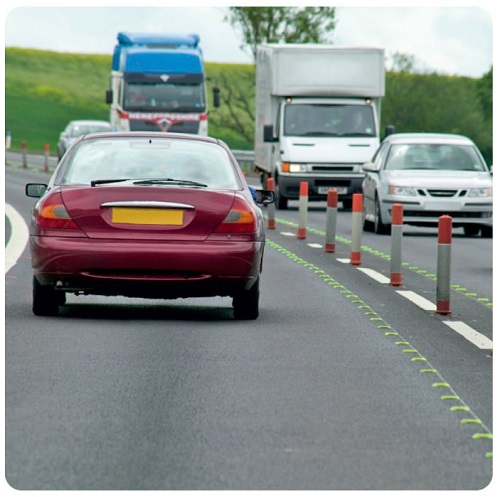
Contraflow systems
Where a temporary contraflow system is in operation, you’ll be travelling close to oncoming traffic, sometimes in narrow lanes. When you enter a contraflow system, you should
• reduce speed in good time
• choose an appropriate lane in good time
• keep the correct separation distance.
FAQs
Why does my instructor tell me to keep well to the left before a right-hand bend?
Keeping well to the left improves your view of the road ahead and gives you an earlier indication of any hazards.
How can I park my car safely on a downhill slope?
Apply the parking brake firmly and turn the steering wheel towards the kerb. This will help stop your vehicle rolling downhill.
What are the benefits of a four-wheel-drive vehicle?
It has improved road holding. The extra grip helps when travelling on slippery or uneven roads.
I know overtaking is a dangerous manoeuvre – are there any places that I definitely need to avoid?
Always ensure you’ve enough time to complete the manoeuvre safely. In particular, do not overtake
-
where your view ahead is blocked (for example, by a bend)
-
when approaching a junction
-
if you’re intending to turn off the road shortly afterwards.
Why are there so many speed humps around?
These traffic-calming measures are normally found in built-up areas to improve the safety of the area. Slow right down as you approach and drive over them.
About the Course
Our driving theory test course is designed to make learning simple, structured, and effective. With 14 modules and 140 bite-sized lessons, the entire syllabus is broken down into easy-to-digest sections you can work through at your own pace. Each module includes engaging videos, clear summaries in spider-diagram format, and a test to check your knowledge before moving on. You’ll also have access to unlimited mock exams and hazard perception practice, so you can build confidence as you go. Fully updated for 2026 and mobile-friendly, the course lets you study anytime, anywhere, and track your progress as you prepare for test success.
What You’ll Learn
- The complete driving theory syllabus, divided into 14 clear modules
- Key knowledge explained in short, manageable lessons
- How to spot and respond to hazards with practical hazard perception training
- Retain more information with videos, images, and spider diagram summaries
- Test your knowledge with module quizzes and unlimited mock tests
- Build confidence step by step by tracking your progress
- Study effectively on any device — PC, tablet, or mobile
- Be fully prepared with up-to-date material for 2026 and beyond
