
Vehicle handling
Introduction
Various conditions can affect the handling of your vehicle. These can roughly be divided into
-
weather and light conditions
-
control and speed
-
road surfaces.
Weather conditions
Rain or wet conditions
When it’s raining or the road is wet, leave at least double the normal stopping distance. If you’re following a vehicle at a safe distance and another vehicle pulls into the gap you’ve left, drop back to regain a safe distance.
On wet roads, watch out for motorcyclists, who may suddenly change direction to avoid slippery drain covers.
If visibility is poor during the day use dipped headlights to help other road users see you. If visibility becomes seriously reduced, you MUST use dipped headlights. ‘Seriously reduced’ means you cannot see for more than about 100 metres (328 feet).
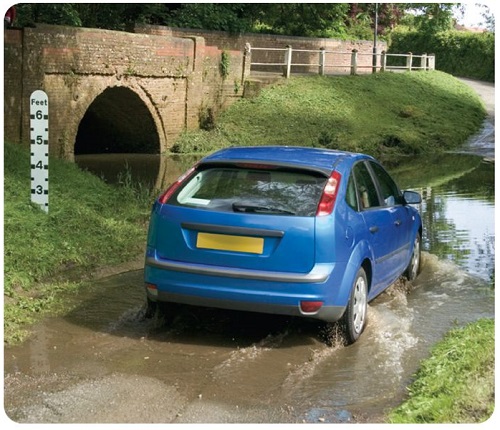
In winter, a ford is more likely to flood, making it difficult to cross. There may be a depth gauge, which will help you decide whether you should go through. If you decide to continue
-
use a low gear
-
drive through slowly
-
test your brakes afterwards: wet brakes are less effective.
Fog
When visibility is seriously reduced, you MUST use headlights. You may also use fog lights if you have them.
Never use front or rear fog lights unless visibility is seriously reduced. If you’ve been using them and conditions improve, remember to switch them off. Do not use fog lights when they’re not needed, because
-
you may be breaking the law
-
they can dazzle other road users
-
road users behind you will not be able to see your brake lights as clearly, so they may not react in time to stop safely
-
road users behind you may mistake your fog lights for brake lights and slow unnecessarily.
In foggy weather, you cannot see as far as you can in good conditions, so always keep your speed down. Increase your distance from the vehicle in front, in case it stops or slows suddenly. Allow more time for your journey.
When driving on motorways in fog, reflective studs will help you to see the road ahead and also help you to know which lane you’re in.
-
Red studs mark the left-hand edge of the carriageway
-
Amber studs mark the central reservation.
Very bad weather
If it’s very foggy or snow is falling heavily, do not travel unless your journey is essential. If you must travel, take great care and allow plenty of time.
Before you start out, make sure that
-
your lights are working
-
your windows are clean.
In deep snow, consider fitting snow chains to your wheels to help grip and prevent skidding.
When on the road, keep well back – increase the gap between your vehicle and the one in front in case it stops suddenly. In icy conditions your stopping distance can be 10 times further than it would be in dry conditions.
Windy weather
Wind can affect all vehicles. A sudden gust may catch your vehicle
-
when passing a high-sided vehicle on the motorway
-
when driving on an exposed stretch of road.
Driving at night
Make sure that your headlights do not dazzle
• the vehicle you’re following
• any oncoming traffic
• other road users.
If you’re dazzled by the headlights of an oncoming vehicle, slow down or stop to remain in full control.
Be extra careful when you overtake at night. You cannot see as far ahead and there may be bends in the road.
On a motorway, use
• dipped headlights, even if the road is well lit
• sidelights if you’ve broken down and are parked on the hard shoulder. This will help other road users to see you.
Control and speed
Keep full control of your vehicle at all times. Driving with the clutch down or in neutral for any length of time (coasting) reduces control, especially of steering and braking. This is especially dangerous when travelling downhill, as the vehicle will pick up speed quickly and there’s no engine braking.
You can use your vehicle’s engine to help control your speed. Select a lower gear when driving down a steep hill. This can be especially important as your brakes may become less effective due to overheating.
When driving up a steep hill, the engine will work harder and you’ll slow down sooner.
Take extra care on a single-track road. If you see a vehicle coming towards you, pull into, or opposite, a passing place.
Always drive in accordance with the conditions. Your stopping distance will be affected by
• your speed
• the condition of your tyres
• the weather.
Try to avoid skidding, as it can be hard to regain control once a skid has started. If you do not have anti-lock brakes and your vehicle begins to skid when you’re braking on a wet road, the first thing you should do is release the footbrake. If the rear wheels of your vehicle begin to skid, steer into the skid by turning the steering wheel in the same direction. Avoid braking suddenly or harshly, as this will make the situation worse.
Traffic calming and road surfaces
Traffic calming is used to slow down traffic and make the roads safer for vulnerable road users, especially pedestrians. One of the most common measures is road humps (sometimes called speed humps). Stay within the speed limit and do not overtake other vehicles within these areas.
In towns where trams operate, the areas used by the trams may have a different surface texture or colour. This may be edged with white line markings.
A rumble device (raised markings across the road) is often used to
-
alert you to a hazard, such as a roundabout
-
encourage you to reduce speed.
FAQs
Am I allowed to wait in a box junction?
Yes, if you want to turn right and your exit’s clear but you’re prevented from turning by oncoming traffic.
Do I need to leave sidelights on when I park on a two-way road?
Leave your sidelights on
-
if the speed limit’s more than 30 mph (48 km/h)
-
when it’s foggy.
Always park on the left-hand side of the road.
About the Course
Our driving theory test course is designed to make learning simple, structured, and effective. With 14 modules and 140 bite-sized lessons, the entire syllabus is broken down into easy-to-digest sections you can work through at your own pace. Each module includes engaging videos, clear summaries in spider-diagram format, and a test to check your knowledge before moving on. You’ll also have access to unlimited mock exams and hazard perception practice, so you can build confidence as you go. Fully updated for 2026 and mobile-friendly, the course lets you study anytime, anywhere, and track your progress as you prepare for test success.
What You’ll Learn
- The complete driving theory syllabus, divided into 14 clear modules
- Key knowledge explained in short, manageable lessons
- How to spot and respond to hazards with practical hazard perception training
- Retain more information with videos, images, and spider diagram summaries
- Test your knowledge with module quizzes and unlimited mock tests
- Build confidence step by step by tracking your progress
- Study effectively on any device — PC, tablet, or mobile
- Be fully prepared with up-to-date material for 2026 and beyond
