
Vehicle loading
Vehicle stability
You are responsible for making sure that your vehicle is not overloaded. Overloading can seriously affect the vehicle’s handling, especially the steering and braking. Distribute any load evenly.
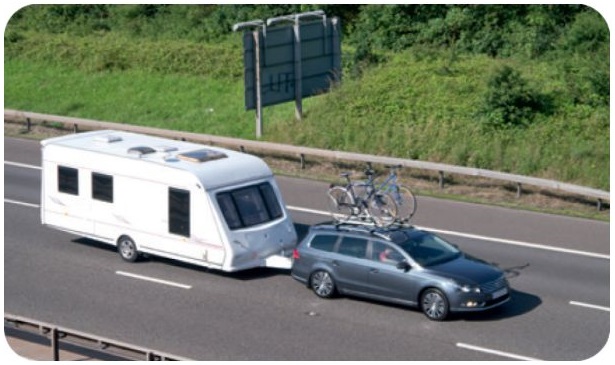
Securely fasten any load carried on a roof rack. A heavy load will reduce the stability of your vehicle.
When carrying or towing a heavy load, you may need to adjust your vehicle’s tyre pressures and headlight aim.
Make sure the load does not obstruct your view when you’re driving, or stick out where it could be a danger to other road users.
Passengers
All passengers MUST wear seat belts if they’re fitted. The driver is responsible for making sure that all children (under 14 years) wear a suitable restraint. The type of restraint varies with the age of the child but it MUST be suitable for the child’s weight and size.
Under no circumstances should a passenger travel in a caravan while it’s being towed.
Animals should be restrained to make sure that they do not distract you or block your view.
Towing
If you passed your car driving test after 1 January 1997 you are restricted to towing trailers that weigh up to 3,500 kg maximum authorised mass (MAM). If you’re planning to tow a caravan, it’ll help the handling of your vehicle if you have a stabiliser fitted to your tow bar. This will be particularly helpful when it’s windy.
Your caravan or trailer MUST be fitted with a secondary coupling device if it is unbraked or weighs less than 1.5 tonnes. Typically, this will be either a chain or cable. If the main coupling fails, the secondary coupling will keep the trailer connected to the towing vehicle. Braked trailers or caravans, weighing over 1.5 tonnes, MUST be fitted with a breakaway cable that will apply the brakes if the coupling fails.
If a trailer or caravan starts to swerve or snake as you’re driving along, ease off the accelerator and reduce your speed gradually to regain control.
There’s a lower national speed limit for all vehicles towing trailers.
-
On a dual carriageway or motorway it’s 60 mph (96 km/h). In England, Scotland and Wales, on a motorway that has more than 2 lanes, you MUST NOT drive in the right-hand lane
-
On a single carriageway it’s 50 mph (80 km/h).
FAQs
Should my tyres always be inflated to the same pressure?
Inflate your tyres to a higher pressure
-
when you’re carrying a heavy load
-
if you’re driving fast for a long distance, such as on a motorway.
Your vehicle handbook should tell you the correct pressure for different circumstances.
How will I know the maximum weight that can be put on the tow bar?
The maximum noseweight which should be applied to your vehicle’s tow bar can normally be found in the vehicle handbook.
About the Course
Our driving theory test course is designed to make learning simple, structured, and effective. With 14 modules and 140 bite-sized lessons, the entire syllabus is broken down into easy-to-digest sections you can work through at your own pace. Each module includes engaging videos, clear summaries in spider-diagram format, and a test to check your knowledge before moving on. You’ll also have access to unlimited mock exams and hazard perception practice, so you can build confidence as you go. Fully updated for 2026 and mobile-friendly, the course lets you study anytime, anywhere, and track your progress as you prepare for test success.
What You’ll Learn
- The complete driving theory syllabus, divided into 14 clear modules
- Key knowledge explained in short, manageable lessons
- How to spot and respond to hazards with practical hazard perception training
- Retain more information with videos, images, and spider diagram summaries
- Test your knowledge with module quizzes and unlimited mock tests
- Build confidence step by step by tracking your progress
- Study effectively on any device — PC, tablet, or mobile
- Be fully prepared with up-to-date material for 2026 and beyond
