
Vulnerable road users
Introduction
The most vulnerable road users are pedestrians, cyclists, motorcyclists and horse riders. Always be aware of their presence and treat them with respect. It’s particularly important to show consideration to children, older people and disabled people.
Learners, inexperienced and older drivers are the most vulnerable types of driver.
Pedestrians
Pedestrians normally use a pavement or footpath. Take extra care if they have to walk in the road
• when the pavement is closed due to street repairs
• on country roads where there’s no pavement.
On country roads, pedestrians are advised to walk on the right-hand side of the road so they’re facing oncoming traffic. Signs may warn you of people walking in the road.
A large group of people, such as those on an organised walk, may walk on the left-hand side. At night, delegated people at the front and rear of the group should carry bright lights – white at the front, red at the rear – to warn approaching vehicles of their presence.
Watch out for pedestrians already crossing when you’re turning into a side road. They have priority, so wait for them to cross.
Be ready to slow down and stop as you approach a pedestrian crossing.
• Zebra crossings – slow down and prepare to stop if someone is waiting to cross.
• Pelican crossings are light-controlled. During the flashing amber phase, give way to pedestrians on the crossing. If the lights change to green while someone is still crossing, be patient and wait until they’ve finished crossing.
• Puffin crossings have sensors to detect when people are on the crossing. The lights do not change from red until the crossing is clear.
• Toucan crossings – cyclists can cross at the same time as pedestrians. There’s no flashing amber phase.
Children
Children are particularly vulnerable as road users because they can be unpredictable. They’re less likely than other pedestrians to look before stepping into the road.
Drive carefully near schools.
-
There may be flashing amber lights under a school warning sign. Reduce your speed until you’re clear of the area.
-
Be prepared for a school crossing patrol to stop the traffic by stepping out into the road with a stop sign.
Do not wait or park on yellow zigzag lines outside a school. A clear view of the crossing area outside the school is needed by
-
drivers on the road
-
pedestrians on the pavement.
Buses and coaches carrying schoolchildren show a special sign in the back. This indicates that they may stop frequently and not just at normal bus stops.
Older and disabled pedestrians
If you see older people about to cross the road ahead, be careful as they may have misjudged your speed. If they’re crossing, be patient and allow them to cross in their own time.
Treat disabled pedestrians as you would able-bodied ones, but be patient as they may need extra time to cross the road.
A pedestrian with hearing difficulties may have a dog with a distinctive yellow or burgundy coloured coat.
A person carrying a white stick with a red band, or walking with a dog wearing a red-and-white checked harness, is both deaf and blind.
Take extra care, as they may not be aware of vehicles approaching.
Cyclists
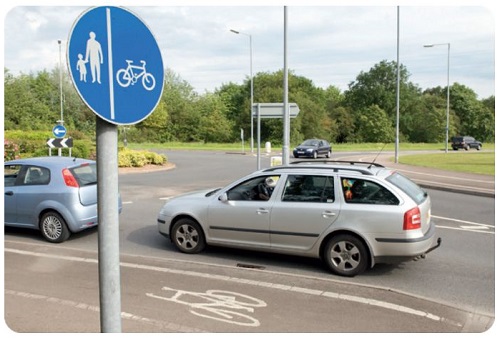
Cyclists should normally follow the same rules as drivers, but they’re slower and more vulnerable. In some areas, signs may indicate special cycle or shared cycle and pedestrian routes.
Advanced stop lines are provided to allow cyclists to position themselves in front of other traffic.
When the lights are red or about to become red, you should stop at the first white line.
If you’re overtaking a cyclist, leave at least 1.5 metres of space at speeds of up to 30 mph, and give them more space when overtaking at higher speeds. They may need to swerve
• to avoid a drain or an uneven road surface
• if they’re affected by the wind.
A cyclist going slowly, or glancing over their shoulder to check for traffic, may be planning to turn right. Stay behind and give them plenty of room.
Never overtake a cyclist (or moped) just before you turn left. Hold back and wait until they’ve passed the junction before you turn.
When you’re emerging from a junction, look carefully for cyclists. They’re not as easy to see as larger vehicles. Also look out for cyclists emerging from junctions.
Be aware of cyclists at a roundabout. They’re slower and more vulnerable than other road users, and may decide to stay in the left-hand lane whatever direction they’re planning to take. Hold back and give them plenty of room.
Motorcyclists
Several of the previous points are also relevant to motorcyclists. Remember to leave extra room while following or overtaking a motorcycle, and look out for indications that they may be about to turn right. Look carefully for them at junctions, as they’re smaller than other road users and are harder to see.
When you’re moving in queues of traffic, be aware that motorcyclists may
• filter between lanes
• cut in just in front of you
• pass very close to you.
Before you turn right, always check for other traffic, especially motorcyclists, who may be overtaking.
If there’s a slow-moving motorcyclist ahead and you’re unsure what the rider is going to do, stay behind them in case they need to change direction suddenly.
In order to improve their visibility, motorcyclists often wear bright clothing and ride with dipped headlights, even during the day.
Motorcyclists also wear safety equipment, such as a helmet, to protect themselves. If there’s been an accident and you find a motorcyclist has been injured, seek medical assistance. Do not remove their helmet unless it’s essential.
Animals
Always drive carefully if there are horses or other animals on the road. Go very slowly and be ready to stop.
When it’s safe to overtake
• drive slowly
• leave plenty of room.
Take particular care when approaching a roundabout. Horse riders, like cyclists, may keep to the left, even if they’re signalling right. Stay well back.
Other drivers
The reactions of other drivers, especially inexperienced or older drivers, may be slower than yours. Learner drivers may make a mistake, such as stalling at a junction. Try to be patient.
Statistics show that 17- to 25-year-olds are the most likely to be involved in a road incident. Newly qualified drivers can decrease their risk of incidents, particularly on the motorway, by taking further training. Find out more about the Pass Plus scheme from your ADI, by calling DVSA on 0115 936 6504 or by visiting www.gov.uk/pass-plus (Pass Plus is not available in Northern Ireland.)
FAQs
Reversing seems to be a dangerous manoeuvre. How can I be sure it’s safe?
Always check the area behind the car very carefully. Look especially for children, who are difficult to see. Get out and check if you’re not sure. Stop and give way to any pedestrians crossing the road behind you.
What should I do if parked vehicles restrict my view when emerging from a junction?
Stop, then creep forward slowly until you have a clear view.
How can I tell if someone is going to cross the road between parked cars?
You cannot, but look for tell-tale signs such as a ball bouncing out into the road or a bicycle wheel sticking out between cars. Slow down and be prepared to stop.
Who is most vulnerable at road junctions?
Junctions are dangerous places, especially for those who cannot be seen as easily, for example, pedestrians, cyclists and motorcyclists. Always take extra care.
What does a flashing amber beacon on the top of a vehicle mean?
This indicates a slow-moving vehicle. A powered vehicle used by a disabled person MUST have a flashing amber light when travelling on a dual carriageway.
Why do I need to be careful if a bus has stopped on the other side of the road?
Pedestrians may come from behind the bus and cross the road, or dash across from your left.
If I have a collision, what’s the first thing I have to do?
Stop. By law, you MUST stop at the scene of the incident if damage or injury is caused to any other person, vehicle, animal or property.
What can I do if I’m being dazzled by the vehicle behind?
Set your interior mirror to anti-dazzle, if you’re able. Slow down and stop if you cannot see.
About the Course
Our driving theory test course is designed to make learning simple, structured, and effective. With 14 modules and 140 bite-sized lessons, the entire syllabus is broken down into easy-to-digest sections you can work through at your own pace. Each module includes engaging videos, clear summaries in spider-diagram format, and a test to check your knowledge before moving on. You’ll also have access to unlimited mock exams and hazard perception practice, so you can build confidence as you go. Fully updated for 2026 and mobile-friendly, the course lets you study anytime, anywhere, and track your progress as you prepare for test success.
What You’ll Learn
- The complete driving theory syllabus, divided into 14 clear modules
- Key knowledge explained in short, manageable lessons
- How to spot and respond to hazards with practical hazard perception training
- Retain more information with videos, images, and spider diagram summaries
- Test your knowledge with module quizzes and unlimited mock tests
- Build confidence step by step by tracking your progress
- Study effectively on any device — PC, tablet, or mobile
- Be fully prepared with up-to-date material for 2026 and beyond
